Where Will the Water Go? Wet Weather Checklist to keep rain where it belongs – AWAY from the foundation.
September days are warm, the evenings are cooler, and there’s still time to enjoy the garden before the season turns. It’s also an ideal time to do a little detective work, paying particular attention to how water moves around your property – and whether it’s draining to where it should.
Good drainage protects the structure of your home, foundation, landscaping, and walkways.
Start at the top – the roof and eavestroughs.
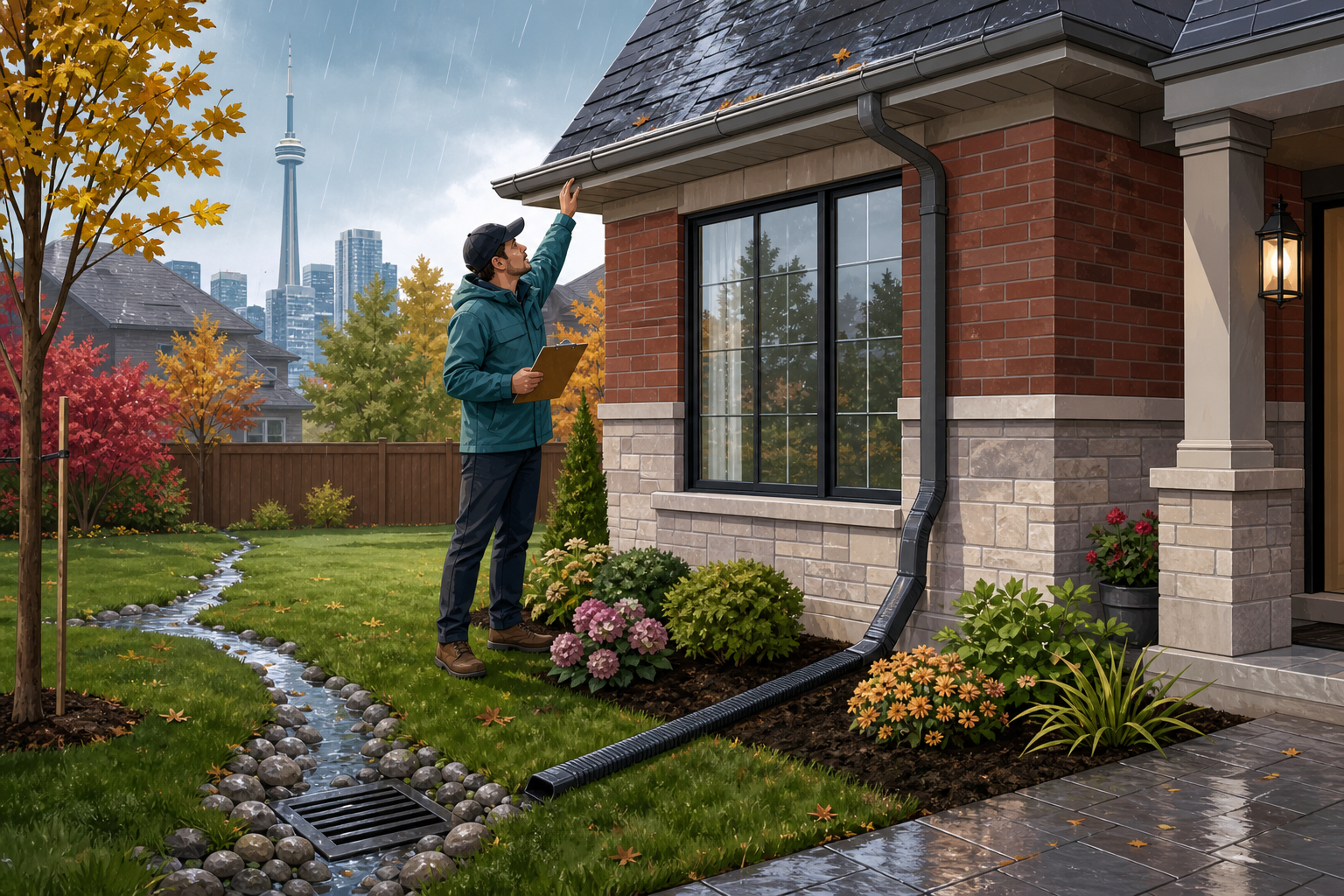
When rain falls, water should move from the roof into the eavestroughs, through the downspouts, and then away from the foundation. Eavestroughs need a slight slope to successfully guide rainwater toward the downspouts, and even a small sag can create a low point where water collects and adds weight. Over time, that can cause the eavestrough to pull away from the roof edge, making drainage even less effective and potentially damaging the roof edge.
If you have eavestrough guards, don’t assume you can forget about maintenance. While gutter-guards reduce the amount of debris that gets into your eavestroughs, leaves and other debris can still accumulate on top. If enough debris builds up, it will block water from actually getting into the eavestrough, causing it to gush over the edges onto the ground and likely into the attic space too.
Follow the water to the downspouts.
Perfectly clean eavestroughs won’t do much good if the downspout is dumping water directly beside the foundation. Check each downspout to make sure it’s free of blockages and then follow its discharge point. Ideally, water should be directed away from the home and onto an area where it can disperse without flowing back toward the foundation or pooling beside a driveway or walkway. Extensions help, but they need to be positioned with the slope of the property in mind.
If your home has underground downspout drains, this is the time to make sure they’re functioning. Once the ground freezes, it will be impossible. During rain, watch for water pooling where the downspout enters the ground or a lack of water coming from the pipe’s exit point.
You can also test the line with a garden hose – disconnect the downspout or open the top adapter, place the hose into the underground pipe and turn the water on. If water quickly backs up and spills out around the opening rather than flowing through the pipe, there’s likely a clog that should be addressed before winter.
Your home’s grading does some of the most important work.
Ideally, the ground around the foundation should slope down from the house so rainwater naturally moves away rather than sitting against the foundation wall. A 5% slope is ideal – soil beside the foundation should be approximately 8 cm higher than the soil 1.5 m away from the foundation.
You don’t need surveying equipment to spot an obvious problem. Walk around the house after rainfall and look for puddles, check for areas where soil has settled, and top up settled areas with fresh soil to help restore the slope and direct water away from your home.
Keeping water moving away from your home prevents basement moisture – AKA leaks. Good drainage equals a dry basement.



September days are warm, the evenings are cooler, and there’s still time to enjoy the garden before the season turns. It’s also an ideal time to do a little detective work, paying particular attention to how water moves around your property – and whether it’s draining to where it should.
Good drainage protects the structure of your home, foundation, landscaping, and walkways.
Start at the top – the roof and eavestroughs.
When rain falls, water should move from the roof into the eavestroughs, through the downspouts, and then away from the foundation. Eavestroughs need a slight slope to successfully guide rainwater toward the downspouts, and even a small sag can create a low point where water collects and adds weight. Over time, that can cause the eavestrough to pull away from the roof edge, making drainage even less effective and potentially damaging the roof edge.
If you have eavestrough guards, don’t assume you can forget about maintenance. While gutter-guards reduce the amount of debris that gets into your eavestroughs, leaves and other debris can still accumulate on top. If enough debris builds up, it will block water from actually getting into the eavestrough, causing it to gush over the edges onto the ground and likely into the attic space too.
Follow the water to the downspouts.
Perfectly clean eavestroughs won’t do much good if the downspout is dumping water directly beside the foundation. Check each downspout to make sure it’s free of blockages and then follow its discharge point. Ideally, water should be directed away from the home and onto an area where it can disperse without flowing back toward the foundation or pooling beside a driveway or walkway. Extensions help, but they need to be positioned with the slope of the property in mind.
If your home has underground downspout drains, this is the time to make sure they’re functioning. Once the ground freezes, it will be impossible. During rain, watch for water pooling where the downspout enters the ground or a lack of water coming from the pipe’s exit point.
You can also test the line with a garden hose – disconnect the downspout or open the top adapter, place the hose into the underground pipe and turn the water on. If water quickly backs up and spills out around the opening rather than flowing through the pipe, there’s likely a clog that should be addressed before winter.
Your home’s grading does some of the most important work.
Ideally, the ground around the foundation should slope down from the house so rainwater naturally moves away rather than sitting against the foundation wall. A 5% slope is ideal – soil beside the foundation should be approximately 8 cm higher than the soil 1.5 m away from the foundation.
You don’t need surveying equipment to spot an obvious problem. Walk around the house after rainfall and look for puddles, check for areas where soil has settled, and top up settled areas with fresh soil to help restore the slope and direct water away from your home.
Keeping water moving away from your home prevents basement moisture – AKA leaks. Good drainage equals a dry basement.
Read Next
7 Essential Checks Before You Buy in 2026: Building Confidence Through the Numbers
Getting Lenders to Count 80% of Your Gross Rent: A Checklist
820 Low-Rise Homes, 129 Condos: The GTA Slump Belongs to Speculators
200 Basis Points or 2 Percentage Points: Same Stress Test, Clearer Wording