820 Low-Rise Homes, 129 Condos: The GTA Slump Belongs to Speculators
For six straight months, GTA builders have sold more new low-rise homes than their ten-year average, and most people still describe the market as a slump. In September 2026, according to BILD and Altus Group, 820 new detached, semi-detached and townhouses sold across the region, 17% above the September norm. Over the same month, new high-rise condo sales fell to 129 units, the lowest September on record.
The usual reading of a soft market is to wait, and on the national numbers that reading holds up. CREA reports home sales in September 2026 were down 6.9% from a year earlier, and the national average price in August sat at $668,219, up just 0.6% year over year. That's a flat market by any measure. The mistake is treating the GTA as one market. The pain is concentrated in one kind of buyer, and if you're investing, building or buying a home here, knowing which buyer is hurting tells you far more than any average.
A purchase that needs rising prices breaks first
The pre-construction condo model in Toronto ran on a simple bet. An investor put down a deposit on a unit years before completion, expecting that by closing the unit would be worth more than the contract price. The profit came from appreciation or an assignment sale. Rent was a secondary concern, and on many small units it never covered the carrying costs anyway.
That bet only works when prices keep climbing. Once they flatten, the investor is left with a unit that costs more each month than it brings in and resells for roughly what they paid, or less. Many units launched at peak pricing are now sitting unsold, competing with resale condos and with low-rise homes whose price gap has narrowed. Fewer new investors want in, so sales collapse.
A family buying a townhouse in Vaughan is making a different calculation. They need bedrooms, a yard and a school. Their purchase works as long as they can carry the mortgage, whether prices rise or sit still for five years. That kind of demand doesn't vanish when appreciation stalls, which is why York Region keeps absorbing new ground-oriented homes while downtown towers struggle.
The test you can apply to any deal: if prices stayed exactly where they are for five years, would this purchase still make sense? If the answer depends on a resale gain, you're holding the same risk the condo market just repriced.
The cracks run both ways
Low-rise strength comes with its own risks. New detached homes in the GTA often run well past $1.5 million, and buyers closing on contracts signed in 2022 or 2023 may face higher carrying costs than they planned for. Demand also thins out the farther you move from established 905 hubs like Vaughan and Markham.
Weak condo sales don't mean first-time buyers stopped wanting condos, either. For many, a condo remains the only realistic first step. The record low says more about speculative appetite and pricing than about whether young buyers still need a place to live.
Financing follows the buyers who are actually showing up
Lenders watch the same data. When a condo project struggles to sell, appraisals on those units can come in cautious, and a buyer closing on a pre-construction purchase may find the bank values it below the contract price, leaving a gap to fund in cash. Strong, steady low-rise sales give lenders comparable sales to rely on, which tends to make appraisals on ground-oriented homes more predictable.
If you're self-employed and eyeing a low-rise home, get organized before you write an offer. Most lenders will want your last two years of T1 Generals and Notices of Assessment, plus business financial statements if you're incorporated. Business-for-self programs can work with lower declared income, usually with a larger down payment and closer scrutiny of your bank deposits. Sorting this out early means your financing condition clears inside the deadline instead of stalling it.
So before you decide whether to wait out this market, look at who is still buying the thing you want, and whether their reason for buying survives a few years of flat prices. In the GTA right now, the slump belongs to anyone whose plan needed prices to rise.


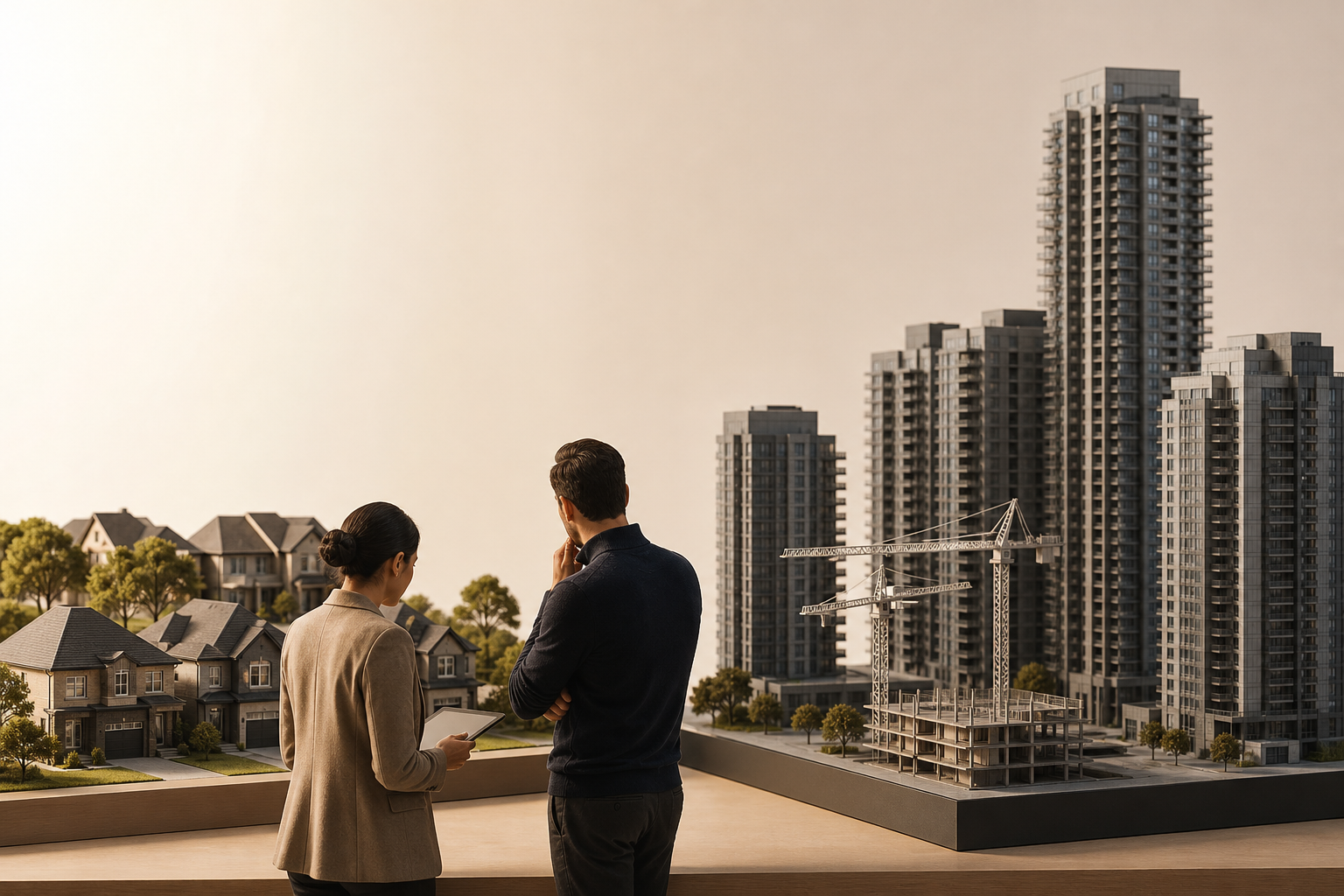

For six straight months, GTA builders have sold more new low-rise homes than their ten-year average, and most people still describe the market as a slump. In September 2026, according to BILD and Altus Group, 820 new detached, semi-detached and townhouses sold across the region, 17% above the September norm. Over the same month, new high-rise condo sales fell to 129 units, the lowest September on record.
The usual reading of a soft market is to wait, and on the national numbers that reading holds up. CREA reports home sales in September 2026 were down 6.9% from a year earlier, and the national average price in August sat at $668,219, up just 0.6% year over year. That's a flat market by any measure. The mistake is treating the GTA as one market. The pain is concentrated in one kind of buyer, and if you're investing, building or buying a home here, knowing which buyer is hurting tells you far more than any average.
A purchase that needs rising prices breaks first
The pre-construction condo model in Toronto ran on a simple bet. An investor put down a deposit on a unit years before completion, expecting that by closing the unit would be worth more than the contract price. The profit came from appreciation or an assignment sale. Rent was a secondary concern, and on many small units it never covered the carrying costs anyway.
That bet only works when prices keep climbing. Once they flatten, the investor is left with a unit that costs more each month than it brings in and resells for roughly what they paid, or less. Many units launched at peak pricing are now sitting unsold, competing with resale condos and with low-rise homes whose price gap has narrowed. Fewer new investors want in, so sales collapse.
A family buying a townhouse in Vaughan is making a different calculation. They need bedrooms, a yard and a school. Their purchase works as long as they can carry the mortgage, whether prices rise or sit still for five years. That kind of demand doesn't vanish when appreciation stalls, which is why York Region keeps absorbing new ground-oriented homes while downtown towers struggle.
The test you can apply to any deal: if prices stayed exactly where they are for five years, would this purchase still make sense? If the answer depends on a resale gain, you're holding the same risk the condo market just repriced.
The cracks run both ways
Low-rise strength comes with its own risks. New detached homes in the GTA often run well past $1.5 million, and buyers closing on contracts signed in 2022 or 2023 may face higher carrying costs than they planned for. Demand also thins out the farther you move from established 905 hubs like Vaughan and Markham.
Weak condo sales don't mean first-time buyers stopped wanting condos, either. For many, a condo remains the only realistic first step. The record low says more about speculative appetite and pricing than about whether young buyers still need a place to live.
Financing follows the buyers who are actually showing up
Lenders watch the same data. When a condo project struggles to sell, appraisals on those units can come in cautious, and a buyer closing on a pre-construction purchase may find the bank values it below the contract price, leaving a gap to fund in cash. Strong, steady low-rise sales give lenders comparable sales to rely on, which tends to make appraisals on ground-oriented homes more predictable.
If you're self-employed and eyeing a low-rise home, get organized before you write an offer. Most lenders will want your last two years of T1 Generals and Notices of Assessment, plus business financial statements if you're incorporated. Business-for-self programs can work with lower declared income, usually with a larger down payment and closer scrutiny of your bank deposits. Sorting this out early means your financing condition clears inside the deadline instead of stalling it.
So before you decide whether to wait out this market, look at who is still buying the thing you want, and whether their reason for buying survives a few years of flat prices. In the GTA right now, the slump belongs to anyone whose plan needed prices to rise.
Read Next
7 Essential Checks Before You Buy in 2026: Building Confidence Through the Numbers
Getting Lenders to Count 80% of Your Gross Rent: A Checklist
200 Basis Points or 2 Percentage Points: Same Stress Test, Clearer Wording
A Lower Contract Rate Won't Drop Your Qualifying Rate Below 5.25%