The $671,076 Gap: Why Falling Prices Still Won't Bridge Condo and Detached Home Markets in the GTA
A detached home in the GTA now costs $1,288,669 on average. A condo apartment sits at $617,593. The difference, $671,076, is not a discount you negotiate away. It's a second property you have to find the money for.
That gap is the structural barrier between two housing markets that are technically in the same city but operate on entirely different logics. And while August 2026 brought falling prices across both categories, the distance between them hasn't shrunk. In some cases, it's widened.
Where the equity math breaks
Consider a buyer who purchased a one-bedroom condo in 2021 for $550,000 with a 10% down payment. Today that unit is worth roughly $617,000, a modest gain. After five years of mortgage payments at rates that started low and climbed, they've paid down perhaps $40,000 in principal. Total equity: around $107,000, ignoring transaction costs.
To move into an average detached home at $1,288,669, they need a 20% down payment, $257,734 minimum. Even liquidating the full $107,000 in condo equity leaves a $150,000 shortfall just to meet the down payment threshold. That's before land transfer tax, legal fees, or any reserve for closing costs.
The detached buyer, meanwhile, already owned a house. When detached prices drop 1.8% and condo prices drop 3.8%, the dollar gap between the two widens in absolute terms. The percentage move is smaller for the higher-priced asset, but the equity required to bridge the gap grows.
That's the trap. A softer market helps the person buying their first condo. It does almost nothing for the household trying to climb from a condo into a detached home, because they're chasing a spread, not a price.
The missing middle isn't coming back
The traditional solution was the semi-detached home or townhouse, the in-between product that let a condo owner build equity and move laterally before reaching for a full detached property. That inventory has effectively disappeared in the core GTA.
In the GTA, semi-detached homes now average $931,665. Freehold townhouses sit at $882,060. These aren't stepping stones anymore. They're end goals.
Outer GTA suburbs still offer detached homes closer to $900,000, but those come with longer commutes, higher car dependency, and often smaller lots than the pre-2010 equivalent. For a household tied to downtown Toronto for work, the savings don't offset the lifestyle cost.
What's left is a binary: stay in the condo or make a single enormous leap. The middle option has been priced out of the equation.
Why falling prices don't fix it
Market corrections are distributed unevenly. Condos carry more inventory right now because investors are offloading units with high carrying costs, mortgage interest, maintenance fees, and property tax on a non-primary residence add up fast when rates sit above 4%.
Detached homes, by contrast, remain sticky. Families who locked in sub-3.8% mortgages in 2020 and 2021 have no financial incentive to move. Selling triggers land transfer tax on the next purchase, realtor commissions, and the loss of that low rate. They stay put.
The result: condo supply rises, detached supply stays flat, and the price gap holds or widens even as both markets soften.
The $671,076 spread won't close until one of two things happens. Either incomes rise enough to support the debt required to bridge it, household income would need to jump roughly $90,000 to carry an additional $670,000 in mortgage debt at current rates. Or detached inventory floods the market in a way that forces sustained price declines well beyond what condos experience.
Neither is happening in 2026. The gap isn't a pricing anomaly. It's the new structure of the GTA housing market, and it's here until the math changes.


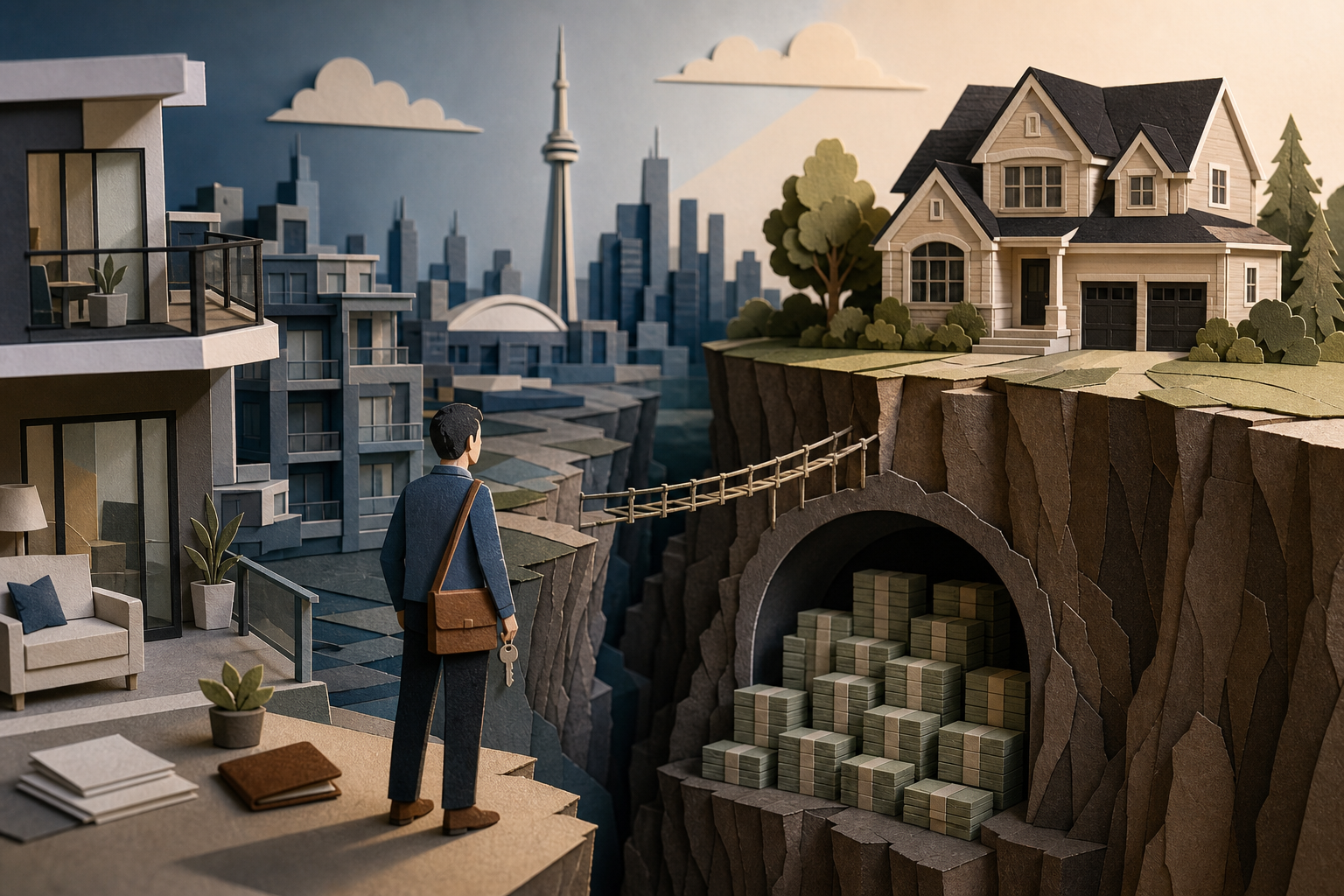

A detached home in the GTA now costs $1,288,669 on average. A condo apartment sits at $617,593. The difference, $671,076, is not a discount you negotiate away. It's a second property you have to find the money for.
That gap is the structural barrier between two housing markets that are technically in the same city but operate on entirely different logics. And while August 2026 brought falling prices across both categories, the distance between them hasn't shrunk. In some cases, it's widened.
Where the equity math breaks
Consider a buyer who purchased a one-bedroom condo in 2021 for $550,000 with a 10% down payment. Today that unit is worth roughly $617,000, a modest gain. After five years of mortgage payments at rates that started low and climbed, they've paid down perhaps $40,000 in principal. Total equity: around $107,000, ignoring transaction costs.
To move into an average detached home at $1,288,669, they need a 20% down payment, $257,734 minimum. Even liquidating the full $107,000 in condo equity leaves a $150,000 shortfall just to meet the down payment threshold. That's before land transfer tax, legal fees, or any reserve for closing costs.
The detached buyer, meanwhile, already owned a house. When detached prices drop 1.8% and condo prices drop 3.8%, the dollar gap between the two widens in absolute terms. The percentage move is smaller for the higher-priced asset, but the equity required to bridge the gap grows.
That's the trap. A softer market helps the person buying their first condo. It does almost nothing for the household trying to climb from a condo into a detached home, because they're chasing a spread, not a price.
The missing middle isn't coming back
The traditional solution was the semi-detached home or townhouse, the in-between product that let a condo owner build equity and move laterally before reaching for a full detached property. That inventory has effectively disappeared in the core GTA.
In the GTA, semi-detached homes now average $931,665. Freehold townhouses sit at $882,060. These aren't stepping stones anymore. They're end goals.
Outer GTA suburbs still offer detached homes closer to $900,000, but those come with longer commutes, higher car dependency, and often smaller lots than the pre-2010 equivalent. For a household tied to downtown Toronto for work, the savings don't offset the lifestyle cost.
What's left is a binary: stay in the condo or make a single enormous leap. The middle option has been priced out of the equation.
Why falling prices don't fix it
Market corrections are distributed unevenly. Condos carry more inventory right now because investors are offloading units with high carrying costs, mortgage interest, maintenance fees, and property tax on a non-primary residence add up fast when rates sit above 4%.
Detached homes, by contrast, remain sticky. Families who locked in sub-3.8% mortgages in 2020 and 2021 have no financial incentive to move. Selling triggers land transfer tax on the next purchase, realtor commissions, and the loss of that low rate. They stay put.
The result: condo supply rises, detached supply stays flat, and the price gap holds or widens even as both markets soften.
The $671,076 spread won't close until one of two things happens. Either incomes rise enough to support the debt required to bridge it, household income would need to jump roughly $90,000 to carry an additional $670,000 in mortgage debt at current rates. Or detached inventory floods the market in a way that forces sustained price declines well beyond what condos experience.
Neither is happening in 2026. The gap isn't a pricing anomaly. It's the new structure of the GTA housing market, and it's here until the math changes.
Sources
Read Next
7 Essential Checks Before You Buy in 2026: Building Confidence Through the Numbers
Getting Lenders to Count 80% of Your Gross Rent: A Checklist
820 Low-Rise Homes, 129 Condos: The GTA Slump Belongs to Speculators
200 Basis Points or 2 Percentage Points: Same Stress Test, Clearer Wording