More Life Insurance, Less Certainty: Why Coverage Growth Doesn't Mean Financial Security
Maria was 34 when she bought her first life insurance policy in 2023. She filled out the online application in nineteen minutes, selected $300,000 in coverage, enough, she thought, to cover the mortgage and keep her two kids fed if she died, and paid the first month's premium. The company sent a confirmation. She checked the box. The subject never came up again until her older sister asked her, last month, whether $300,000 would actually be enough now that her mortgage balance had grown, her salary had doubled, and her youngest had started talking about engineering school.
Maria is in the majority. PolicyMe's 2025 life insurance study found that more Canadians hold coverage than in the prior year, but 24% of them lack confidence that the number on the policy would do what it's supposed to do. Ownership is up. Certainty is down. That gap is the story.
The check-box problem
The life insurance market in Canada has shifted toward digital-first platforms that make buying a policy faster than ordering dinner. You answer questions. The algorithm spits out a quote. You click Accept. The friction is gone, and so is the conversation about whether the amount makes sense. The policy exists. The question of whether it's right does not get asked until later, if at all.
For years, the industry framed "not having life insurance" as the problem. Get people covered, the thinking went, and the rest would follow. The data now suggests that getting covered was the easy part. Knowing if you're covered correctly is harder, and most people are finding out they don't know.
What changed between signing and doubting
When someone buys a $500,000 policy in 2020 and revisits it in 2026, the purchasing power of that half-million has been eroded by inflation at a pace the average buyer didn't account for. Groceries cost more. Mortgage rates reset higher. The same benefit that looked solid five years ago now feels thin when measured against what it would actually take to keep a household running if the income disappeared.
Group life insurance through employers adds to the confusion. A policy that pays two times annual salary sounds meaningful until you realize that two times $85,000 is $170,000, and $170,000 won't replace fifteen years of lost income, cover a $620,000 mortgage, and fund two post-secondary educations. The coverage exists. The gap also exists. Most people don't run the math until something forces them to.
Portability and the gig-economy trap
Employer-provided life insurance has another weakness that workers in 2026 are starting to notice: it's not portable. The layoff rate for Canadian tech workers remains elevated. Contract work is common. The assumption that you'll stay at one company long enough for the group policy to matter is less reliable than it was a generation ago, but the number of people who own individual term policies outside their workplace benefits has not kept pace with that shift.
If you leave the job, the coverage ends. You can convert some group policies to individual ones, but the process is manual and most people don't do it. The insurance exists on paper as long as the employment does. That's a shorter window than it used to be.
The inflation silence
A $250,000 policy taken out in 2015 had more real value then than the same face amount does now. Housing costs have doubled in most markets. The cost of raising children has climbed. As of January 1, 2026, the CPP death benefit is $2,572, and the structure has recently shifted to include a potential top-up for certain estates. The private insurance was supposed to fill the gap. But if the gap has widened and the policy hasn't, the coverage that felt adequate a decade ago is now too small by a margin most holders haven't calculated.
Confidence drops when a number that hasn't grown must cover everything that has: groceries, mortgage payments, education, and the years of income that evaporate if the earner dies.
What the gap actually costs
The consequence of underinsurance doesn't show up until it's too late to fix. The surviving spouse finds out the benefit falls short. The mortgage doesn't get paid off. The education fund doesn't materialize. The policy existed, but it didn't do the thing the buyer thought it would do, and by the time that became clear, the insured was gone and the amount was locked.
PolicyMe's finding that nearly a quarter of insured Canadians doubt their coverage levels is not a marketing problem. It's evidence that the industry solved for acquisition and left customers responsible for the math. They have a number on a page. Whether that number is right is a separate question, and it's the one that matters.

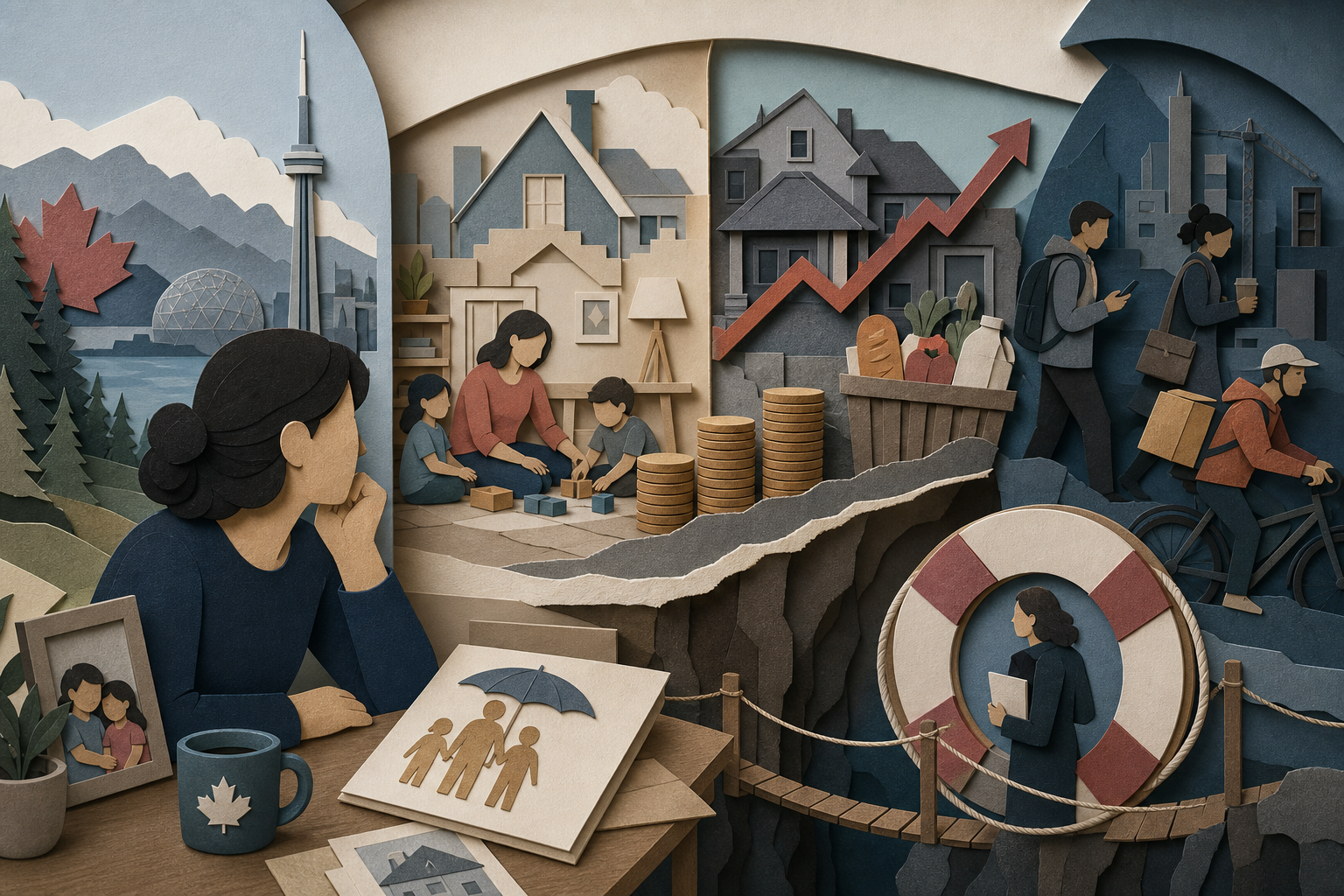

Maria was 34 when she bought her first life insurance policy in 2023. She filled out the online application in nineteen minutes, selected $300,000 in coverage, enough, she thought, to cover the mortgage and keep her two kids fed if she died, and paid the first month's premium. The company sent a confirmation. She checked the box. The subject never came up again until her older sister asked her, last month, whether $300,000 would actually be enough now that her mortgage balance had grown, her salary had doubled, and her youngest had started talking about engineering school.
Maria is in the majority. PolicyMe's 2025 life insurance study found that more Canadians hold coverage than in the prior year, but 24% of them lack confidence that the number on the policy would do what it's supposed to do. Ownership is up. Certainty is down. That gap is the story.
The check-box problem
The life insurance market in Canada has shifted toward digital-first platforms that make buying a policy faster than ordering dinner. You answer questions. The algorithm spits out a quote. You click Accept. The friction is gone, and so is the conversation about whether the amount makes sense. The policy exists. The question of whether it's right does not get asked until later, if at all.
For years, the industry framed "not having life insurance" as the problem. Get people covered, the thinking went, and the rest would follow. The data now suggests that getting covered was the easy part. Knowing if you're covered correctly is harder, and most people are finding out they don't know.
What changed between signing and doubting
When someone buys a $500,000 policy in 2020 and revisits it in 2026, the purchasing power of that half-million has been eroded by inflation at a pace the average buyer didn't account for. Groceries cost more. Mortgage rates reset higher. The same benefit that looked solid five years ago now feels thin when measured against what it would actually take to keep a household running if the income disappeared.
Group life insurance through employers adds to the confusion. A policy that pays two times annual salary sounds meaningful until you realize that two times $85,000 is $170,000, and $170,000 won't replace fifteen years of lost income, cover a $620,000 mortgage, and fund two post-secondary educations. The coverage exists. The gap also exists. Most people don't run the math until something forces them to.
Portability and the gig-economy trap
Employer-provided life insurance has another weakness that workers in 2026 are starting to notice: it's not portable. The layoff rate for Canadian tech workers remains elevated. Contract work is common. The assumption that you'll stay at one company long enough for the group policy to matter is less reliable than it was a generation ago, but the number of people who own individual term policies outside their workplace benefits has not kept pace with that shift.
If you leave the job, the coverage ends. You can convert some group policies to individual ones, but the process is manual and most people don't do it. The insurance exists on paper as long as the employment does. That's a shorter window than it used to be.
The inflation silence
A $250,000 policy taken out in 2015 had more real value then than the same face amount does now. Housing costs have doubled in most markets. The cost of raising children has climbed. As of January 1, 2026, the CPP death benefit is $2,572, and the structure has recently shifted to include a potential top-up for certain estates. The private insurance was supposed to fill the gap. But if the gap has widened and the policy hasn't, the coverage that felt adequate a decade ago is now too small by a margin most holders haven't calculated.
Confidence drops when a number that hasn't grown must cover everything that has: groceries, mortgage payments, education, and the years of income that evaporate if the earner dies.
What the gap actually costs
The consequence of underinsurance doesn't show up until it's too late to fix. The surviving spouse finds out the benefit falls short. The mortgage doesn't get paid off. The education fund doesn't materialize. The policy existed, but it didn't do the thing the buyer thought it would do, and by the time that became clear, the insured was gone and the amount was locked.
PolicyMe's finding that nearly a quarter of insured Canadians doubt their coverage levels is not a marketing problem. It's evidence that the industry solved for acquisition and left customers responsible for the math. They have a number on a page. Whether that number is right is a separate question, and it's the one that matters.
Sources
Read Next
7 Essential Checks Before You Buy in 2026: Building Confidence Through the Numbers
Getting Lenders to Count 80% of Your Gross Rent: A Checklist
820 Low-Rise Homes, 129 Condos: The GTA Slump Belongs to Speculators
200 Basis Points or 2 Percentage Points: Same Stress Test, Clearer Wording