Fortress Flags $1 Trillion AI Infrastructure Bet Private Credit Lenders Are Getting Wrong
A NVIDIA H100 chip cluster financed in late 2024 at $80 million could be worth $40 million by the time the loan matures in 2027 because the B200 series made it obsolete. That's the kind of residual value problem Fortress Investment Group is flagging as private credit piles into AI data centers and GPU clusters at speeds the asset class has never seen before.
The global private credit market now sits at roughly $1.7 trillion USD, with a growing share backing data centers, GPU clusters, and specialized compute hardware for Large Language Models. The pitch sounds sensible: high demand, long-term contracts, hard assets as collateral. The structure looks like equipment finance, but the risk is different.
Hardware cycles don't match loan terms
Traditional private credit thrives on predictable cash flows and stable collateral. A trucking fleet depreciates over a known schedule. A manufacturing line runs for a decade. AI hardware moves on an 18-to-24-month obsolescence curve. Current-generation chips lose peak efficiency long before a five-year loan reaches maturity, and the secondary market for outdated compute is thin to nonexistent.
Fortress's warning centers on this mismatch. Lenders are writing loans at 50% to 70% loan-to-value ratios, standard for equipment finance. But competition is pushing some to offer higher leverage, and that leverage assumes the hardware will hold residual value in a default scenario. It won't. A GPU cluster that can't run the latest models efficiently becomes a power-hungry liability, not a recoverable asset.
The federal government's AI Compute Strategy, launched in 2024 with $2 billion CAD in funding, has accelerated this dynamic in Canada. The AI Compute Access Fund is drawing private capital to domestic data centers to complement public grants. Regions like Vaughan and Brampton are re-zoning industrial land for data centers, chasing proximity to power grids and fiber backbones. The rush is localized and visible.
The hyperscaler choke point
Demand for compute is real. The structural problem is who controls it. Microsoft, Google, and AWS operate at a scale that makes privately funded data centers merchant plays by definition. A startup renting racks in a Vaughan facility is one budget cut away from default, and the landlord's collateral is a building full of chips that only matter if someone needs exactly that configuration at exactly that power cost.
Energy, not silicon, may end up being the real collateral. In Ontario, the bottleneck isn't capital or chips. It's the grid. A secured power drop from Hydro One or Alectra Utilities creates a barrier to entry that actually protects value, because you can't build a data center where the electricity doesn't exist. That scarcity might save lenders from a total glut, but it doesn't solve the obsolescence problem.
FOMO lending looks like this
Private credit grew by offering yield in a low-rate environment. That environment is gone. The Bank of Canada and the Fed are holding rates higher for longer, which makes servicing large loans on data centers and GPU clusters expensive. Lenders who wrote deals in 2023 assuming quick refinancing at lower rates are holding paper that looks worse now.
The comparison Fortress isn't making but should is WeWork. Long-term liabilities backed by short-term, volatile demand. The co-working space bubble imploded when the revenue model couldn't cover the lease obligations. AI data centers have the same shape: multi-year loans secured by chips and servers that need continuous, high-margin utilization to service the debt, in a market where the biggest players can afford to underprice everyone else.
Proponents argue the compute shortage is so acute that even last-generation chips will find buyers for inference tasks or secondary AI applications. Maybe. But that's a hope, not a credit model. If photonic or quantum-ready architectures arrive faster than expected, the collateral for billions in private credit could vaporize overnight.
Fortress is calling it FOMO. The more precise term is basis risk: the gap between what the loan assumes the asset is worth and what it actually recovers. That gap is wide, and it's widening.


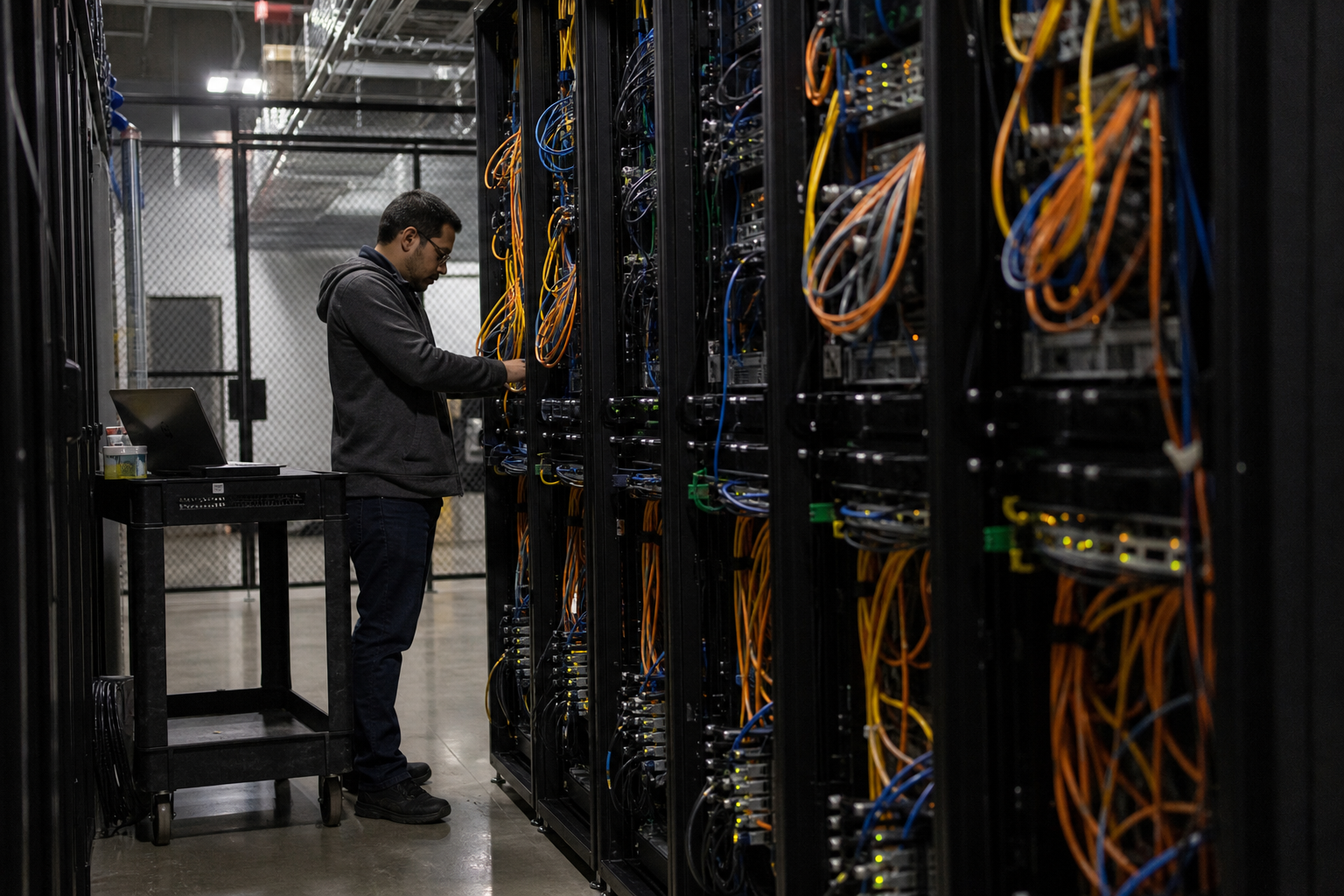

A NVIDIA H100 chip cluster financed in late 2024 at $80 million could be worth $40 million by the time the loan matures in 2027 because the B200 series made it obsolete. That's the kind of residual value problem Fortress Investment Group is flagging as private credit piles into AI data centers and GPU clusters at speeds the asset class has never seen before.
The global private credit market now sits at roughly $1.7 trillion USD, with a growing share backing data centers, GPU clusters, and specialized compute hardware for Large Language Models. The pitch sounds sensible: high demand, long-term contracts, hard assets as collateral. The structure looks like equipment finance, but the risk is different.
Hardware cycles don't match loan terms
Traditional private credit thrives on predictable cash flows and stable collateral. A trucking fleet depreciates over a known schedule. A manufacturing line runs for a decade. AI hardware moves on an 18-to-24-month obsolescence curve. Current-generation chips lose peak efficiency long before a five-year loan reaches maturity, and the secondary market for outdated compute is thin to nonexistent.
Fortress's warning centers on this mismatch. Lenders are writing loans at 50% to 70% loan-to-value ratios, standard for equipment finance. But competition is pushing some to offer higher leverage, and that leverage assumes the hardware will hold residual value in a default scenario. It won't. A GPU cluster that can't run the latest models efficiently becomes a power-hungry liability, not a recoverable asset.
The federal government's AI Compute Strategy, launched in 2024 with $2 billion CAD in funding, has accelerated this dynamic in Canada. The AI Compute Access Fund is drawing private capital to domestic data centers to complement public grants. Regions like Vaughan and Brampton are re-zoning industrial land for data centers, chasing proximity to power grids and fiber backbones. The rush is localized and visible.
The hyperscaler choke point
Demand for compute is real. The structural problem is who controls it. Microsoft, Google, and AWS operate at a scale that makes privately funded data centers merchant plays by definition. A startup renting racks in a Vaughan facility is one budget cut away from default, and the landlord's collateral is a building full of chips that only matter if someone needs exactly that configuration at exactly that power cost.
Energy, not silicon, may end up being the real collateral. In Ontario, the bottleneck isn't capital or chips. It's the grid. A secured power drop from Hydro One or Alectra Utilities creates a barrier to entry that actually protects value, because you can't build a data center where the electricity doesn't exist. That scarcity might save lenders from a total glut, but it doesn't solve the obsolescence problem.
FOMO lending looks like this
Private credit grew by offering yield in a low-rate environment. That environment is gone. The Bank of Canada and the Fed are holding rates higher for longer, which makes servicing large loans on data centers and GPU clusters expensive. Lenders who wrote deals in 2023 assuming quick refinancing at lower rates are holding paper that looks worse now.
The comparison Fortress isn't making but should is WeWork. Long-term liabilities backed by short-term, volatile demand. The co-working space bubble imploded when the revenue model couldn't cover the lease obligations. AI data centers have the same shape: multi-year loans secured by chips and servers that need continuous, high-margin utilization to service the debt, in a market where the biggest players can afford to underprice everyone else.
Proponents argue the compute shortage is so acute that even last-generation chips will find buyers for inference tasks or secondary AI applications. Maybe. But that's a hope, not a credit model. If photonic or quantum-ready architectures arrive faster than expected, the collateral for billions in private credit could vaporize overnight.
Fortress is calling it FOMO. The more precise term is basis risk: the gap between what the loan assumes the asset is worth and what it actually recovers. That gap is wide, and it's widening.
Sources
Read Next
7 Essential Checks Before You Buy in 2026: Building Confidence Through the Numbers
Getting Lenders to Count 80% of Your Gross Rent: A Checklist
820 Low-Rise Homes, 129 Condos: The GTA Slump Belongs to Speculators
200 Basis Points or 2 Percentage Points: Same Stress Test, Clearer Wording