Ford's Tariff Relief Won't Save Hamilton Steel Without a Trade War Strategy
ArcelorMittal Dofasco employs roughly 5,000 people in Hamilton. Stelco another 2,000. When Trump imposed 50% Section 232 tariffs on Canadian steel in June 2024, those mills didn't shut down overnight. They slowed. Shifts shortened. Maintenance crews got cut. The blast furnaces kept running because stopping one costs millions and restarting takes weeks, but the order books thinned and the overtime disappeared. Premier Doug Ford stood in front of cameras last month promising tariff relief packages for affected businesses, the same language Ontario used in 2018 when the last steel war cost the province nearly 40% of its U.S.-bound shipments. The relief then was electricity rebates and workforce training credits. It kept the lights on. It did not stop the hemorrhaging.
The arithmetic doesn't care about provincial budgets
Canada and the U.S. trade $3.6 billion in goods daily. Steel is woven through that figure, raw coil headed south for automakers, fabricated beams coming north for highway bridges and overpasses, the supply chain so integrated that "Canadian" and "American" steel often mean the same ingot crossing the border three times before it becomes a car door. A 50% tariff doesn't just tax the final sale. It breaks the rhythm. U.S. buyers who used to split orders between an Ontario mill and a Indiana mill now consolidate domestic. Canadian mills that relied on just-in-time shipping windows to Michigan assembly plants eat the logistics cost of finding new buyers in Europe or Mexico, markets that don't pay North American premiums and where Chinese overcapacity already undercuts everyone.
Ford's relief can cover some of that gap. The province has allocated hundreds of millions in regional development funds before, and if the tariffs formalize into a long-term barrier, Ontario will likely do it again. But electricity subsidies don't replace export customers. Workforce retraining doesn't help when the problem isn't skill, it's demand. The 2018 precedent is the blueprint here: when U.S. Section 232 tariffs hit that year, Canada responded with C$15.6 billion in countermeasures, and both sides bled for approximately 12 months before an exemption got negotiated. Hamilton survived that round. It survived as a sector that needed life support, not as one that came out stronger.
The green transition compounds the problem
Hamilton's mills are in the middle of a capital-intensive pivot. ArcelorMittal Dofasco has committed to replacing its coal-fired blast furnaces with Electric Arc Furnaces, the lower-carbon technology the federal government is betting on for the electric vehicle supply chain. Stelco, now owned by Cleveland-Cliffs after a 2024 acquisition, faces the same pressure. EAF conversions run into the billions per site. They require long-term certainty, on electricity prices, on carbon policy, on the U.S. export market that buys over 90% of Canada's steel output. A trade war eliminates that certainty. It siphons capital away from retooling and toward survival. You can't build the green steel economy while also fighting a tariff war with your largest customer.
What withstanding pain actually means
Ford's rhetoric about withstanding economic pain isn't wrong. It's incomplete. The pain doesn't distribute evenly. Steelworkers at Dofasco and Stelco will lose shifts before executives lose bonuses. Hamilton's tax base will erode before Queen's Park feels the squeeze. And the tariffs themselves are, in part, a negotiating tactic, the U.S. administration wants Canada to tighten its own borders against offshore Chinese steel routing through Canadian ports. That's a solvable problem. It requires federal action, a customs enforcement overhaul, and a willingness to name China as the actual issue instead of pretending this is about Canadian mills dumping cheap product into Ohio.
Provincial relief keeps the mills from closing in quarter one. A trade strategy that separates Canadian steel from Chinese transshipment keeps them open in year three. Hamilton has survived steel wars before, but survival isn't the same as strategy, and the next round is already pricing in.


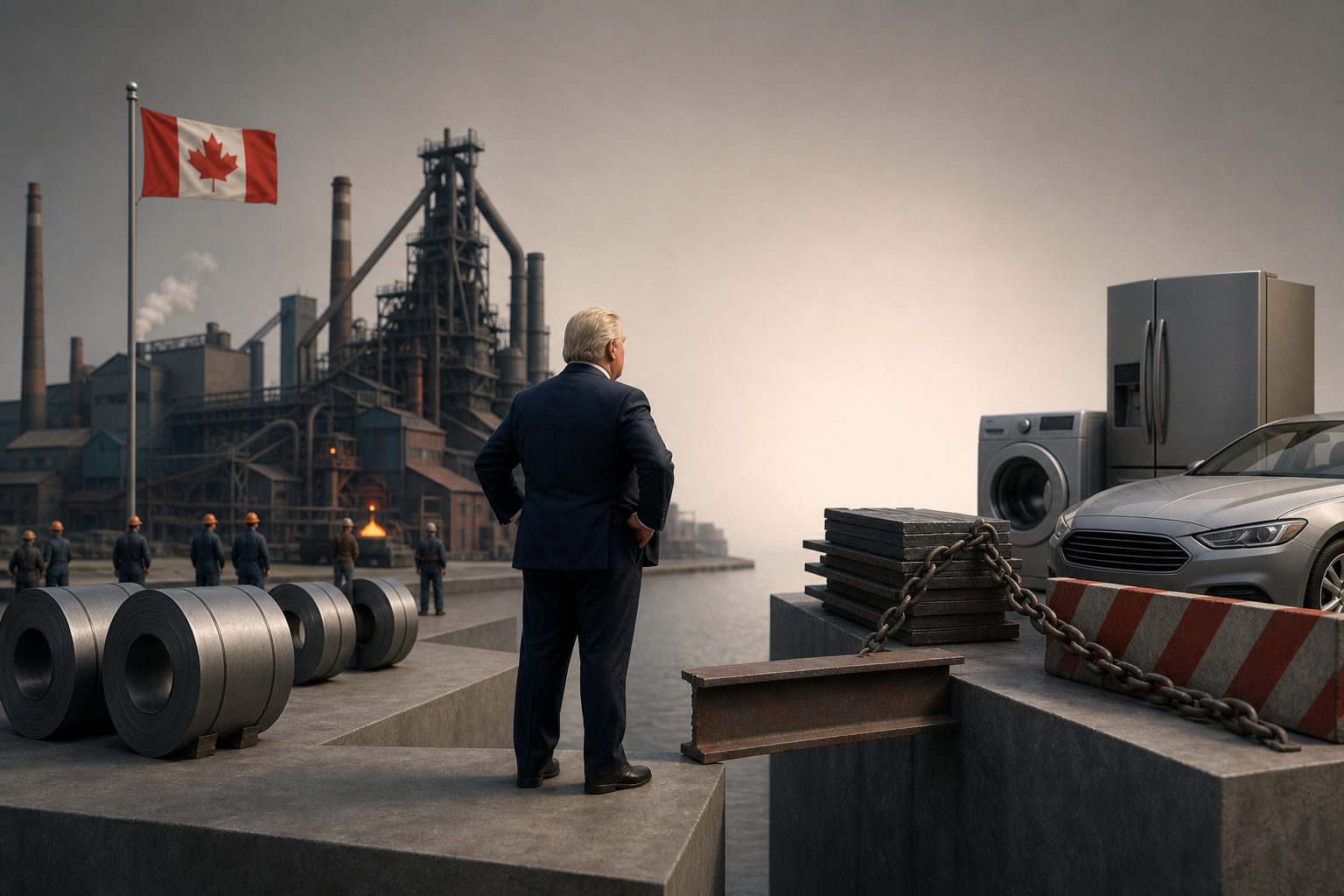

ArcelorMittal Dofasco employs roughly 5,000 people in Hamilton. Stelco another 2,000. When Trump imposed 50% Section 232 tariffs on Canadian steel in June 2024, those mills didn't shut down overnight. They slowed. Shifts shortened. Maintenance crews got cut. The blast furnaces kept running because stopping one costs millions and restarting takes weeks, but the order books thinned and the overtime disappeared. Premier Doug Ford stood in front of cameras last month promising tariff relief packages for affected businesses, the same language Ontario used in 2018 when the last steel war cost the province nearly 40% of its U.S.-bound shipments. The relief then was electricity rebates and workforce training credits. It kept the lights on. It did not stop the hemorrhaging.
The arithmetic doesn't care about provincial budgets
Canada and the U.S. trade $3.6 billion in goods daily. Steel is woven through that figure, raw coil headed south for automakers, fabricated beams coming north for highway bridges and overpasses, the supply chain so integrated that "Canadian" and "American" steel often mean the same ingot crossing the border three times before it becomes a car door. A 50% tariff doesn't just tax the final sale. It breaks the rhythm. U.S. buyers who used to split orders between an Ontario mill and a Indiana mill now consolidate domestic. Canadian mills that relied on just-in-time shipping windows to Michigan assembly plants eat the logistics cost of finding new buyers in Europe or Mexico, markets that don't pay North American premiums and where Chinese overcapacity already undercuts everyone.
Ford's relief can cover some of that gap. The province has allocated hundreds of millions in regional development funds before, and if the tariffs formalize into a long-term barrier, Ontario will likely do it again. But electricity subsidies don't replace export customers. Workforce retraining doesn't help when the problem isn't skill, it's demand. The 2018 precedent is the blueprint here: when U.S. Section 232 tariffs hit that year, Canada responded with C$15.6 billion in countermeasures, and both sides bled for approximately 12 months before an exemption got negotiated. Hamilton survived that round. It survived as a sector that needed life support, not as one that came out stronger.
The green transition compounds the problem
Hamilton's mills are in the middle of a capital-intensive pivot. ArcelorMittal Dofasco has committed to replacing its coal-fired blast furnaces with Electric Arc Furnaces, the lower-carbon technology the federal government is betting on for the electric vehicle supply chain. Stelco, now owned by Cleveland-Cliffs after a 2024 acquisition, faces the same pressure. EAF conversions run into the billions per site. They require long-term certainty, on electricity prices, on carbon policy, on the U.S. export market that buys over 90% of Canada's steel output. A trade war eliminates that certainty. It siphons capital away from retooling and toward survival. You can't build the green steel economy while also fighting a tariff war with your largest customer.
What withstanding pain actually means
Ford's rhetoric about withstanding economic pain isn't wrong. It's incomplete. The pain doesn't distribute evenly. Steelworkers at Dofasco and Stelco will lose shifts before executives lose bonuses. Hamilton's tax base will erode before Queen's Park feels the squeeze. And the tariffs themselves are, in part, a negotiating tactic, the U.S. administration wants Canada to tighten its own borders against offshore Chinese steel routing through Canadian ports. That's a solvable problem. It requires federal action, a customs enforcement overhaul, and a willingness to name China as the actual issue instead of pretending this is about Canadian mills dumping cheap product into Ohio.
Provincial relief keeps the mills from closing in quarter one. A trade strategy that separates Canadian steel from Chinese transshipment keeps them open in year three. Hamilton has survived steel wars before, but survival isn't the same as strategy, and the next round is already pricing in.
Sources
Read Next
7 Essential Checks Before You Buy in 2026: Building Confidence Through the Numbers
Getting Lenders to Count 80% of Your Gross Rent: A Checklist
820 Low-Rise Homes, 129 Condos: The GTA Slump Belongs to Speculators
200 Basis Points or 2 Percentage Points: Same Stress Test, Clearer Wording