Canada's Spring GDP Surge Won't Save It From Prolonged U.S. Trade Retaliation
Canada's Spring GDP Surge Won't Save It From Prolonged U.S. Trade Retaliation
Statistics Canada reported an annualized GDP growth rate of 3.3% in Q2 2026, beating analyst expectations by a comfortable margin. Business investment rose 2.3% in the same quarter, the strongest showing since early 2024. Household consumption held steady despite rising import costs, cushioned by elevated savings rates left over from earlier fiscal cycles. On paper, Canada weathered the first wave of U.S. tariffs without flinching.
The problem is what happens when the cushion runs out.
The Growth Is Real, But the Engine Is Borrowed Time
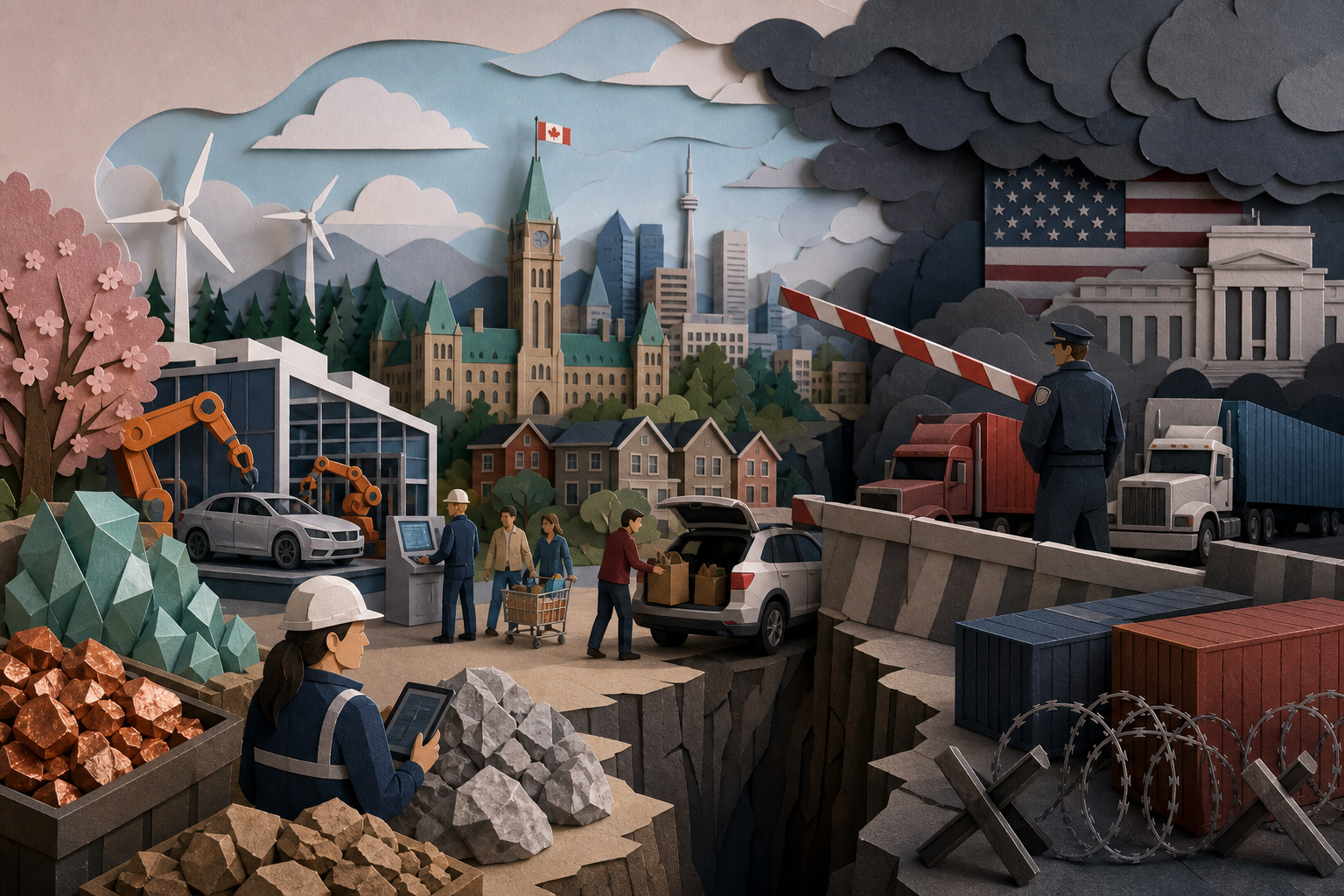
The spring rebound came from three sources. Energy and critical mineral exports stayed strong because global demand for lithium and copper needed for EV production doesn't care what Washington thinks about aluminum tariffs. Businesses front-loaded capital spending to automate before labor shortages got worse and before another round of tariffs hit cross-border machinery purchases. Households kept spending because debt-to-disposable income ratios near 180% still leave room to borrow when savings are high and mortgage rates haven't spiked yet.
None of those three sources are sustainable past 2027.
Export strength in the resource sector masks catastrophic losses in Southern Ontario's automotive corridor, where U.S. domestic-content requirements are gutting integrated supply chains that took thirty years to build. A Mississauga parts manufacturer that ships 80% of its output to Michigan assembly plants doesn't benefit from strong lithium prices in Alberta. The "two Canadas" economy is diverging fast: the resource provinces are thriving, the manufacturing belt is not, and the aggregate GDP number hides which one is structurally vulnerable.
Business investment looks strong until you realize it's a one-time recalibration, not a new baseline. Companies are buying the automation equipment they should have purchased five years ago, accelerated by the realization that cross-border access is now a political variable instead of a trade-agreement constant. Once the capital stock is modernized, that spending stops. It doesn't compound.
The Household Buffer Is Temporary
Canadian household spending has been propped up by two things: population growth and the ability to keep borrowing. Immigration drove consumption through 2025 and into early 2026, but the labor market is already softening in sectors hit hardest by tariffs. Manufacturing employment in Ontario and Quebec is down, and those workers were the marginal consumers keeping retail and services alive in their regions.
The debt-to-income ratio of 179.6% is sustainable only as long as income keeps rising and servicing costs stay manageable. The Bank of Canada's pivot to a "neutral" rate environment in 2026 was designed to balance growth support against the inflationary pressure caused by higher import costs. If the next round of U.S. tariffs pushes tradable goods inflation above 3%, the Bank either lets inflation run hot or raises rates into a slowing economy. Either path kills household spending.
The federal government has rolled out targeted subsidies for industries hit hardest by tariffs, but that risks turning a trade dispute into a subsidy war that Canada cannot win. Washington has deeper pockets and less political patience for foreign industrial support.
The Real Leverage Is Resource Sovereignty
Canada's strongest counter-weight in trade negotiations is its role as the primary supplier of critical minerals for U.S. EV production. Lithium, copper, and rare earth elements flow south because American mines can't scale fast enough to meet domestic demand. That gives Ottawa leverage, but only if it's willing to use it as a negotiating tool rather than a revenue stream.
The spring GDP surge bought time. It proved the economy can absorb the first hit without collapsing. What it didn't prove is that the second, third, and fourth hits won't land harder. Growth fueled by front-loaded investment and borrowed consumption doesn't compound. It exhausts itself.
The question isn't whether Canada's economy found its footing in the spring. The question is whether that footing sits on stable ground or a trapdoor that opens the moment U.S. trade policy shifts again.



Canada's Spring GDP Surge Won't Save It From Prolonged U.S. Trade Retaliation
Statistics Canada reported an annualized GDP growth rate of 3.3% in Q2 2026, beating analyst expectations by a comfortable margin. Business investment rose 2.3% in the same quarter, the strongest showing since early 2024. Household consumption held steady despite rising import costs, cushioned by elevated savings rates left over from earlier fiscal cycles. On paper, Canada weathered the first wave of U.S. tariffs without flinching.
The problem is what happens when the cushion runs out.
The Growth Is Real, But the Engine Is Borrowed Time
The spring rebound came from three sources. Energy and critical mineral exports stayed strong because global demand for lithium and copper needed for EV production doesn't care what Washington thinks about aluminum tariffs. Businesses front-loaded capital spending to automate before labor shortages got worse and before another round of tariffs hit cross-border machinery purchases. Households kept spending because debt-to-disposable income ratios near 180% still leave room to borrow when savings are high and mortgage rates haven't spiked yet.
None of those three sources are sustainable past 2027.
Export strength in the resource sector masks catastrophic losses in Southern Ontario's automotive corridor, where U.S. domestic-content requirements are gutting integrated supply chains that took thirty years to build. A Mississauga parts manufacturer that ships 80% of its output to Michigan assembly plants doesn't benefit from strong lithium prices in Alberta. The "two Canadas" economy is diverging fast: the resource provinces are thriving, the manufacturing belt is not, and the aggregate GDP number hides which one is structurally vulnerable.
Business investment looks strong until you realize it's a one-time recalibration, not a new baseline. Companies are buying the automation equipment they should have purchased five years ago, accelerated by the realization that cross-border access is now a political variable instead of a trade-agreement constant. Once the capital stock is modernized, that spending stops. It doesn't compound.
The Household Buffer Is Temporary
Canadian household spending has been propped up by two things: population growth and the ability to keep borrowing. Immigration drove consumption through 2025 and into early 2026, but the labor market is already softening in sectors hit hardest by tariffs. Manufacturing employment in Ontario and Quebec is down, and those workers were the marginal consumers keeping retail and services alive in their regions.
The debt-to-income ratio of 179.6% is sustainable only as long as income keeps rising and servicing costs stay manageable. The Bank of Canada's pivot to a "neutral" rate environment in 2026 was designed to balance growth support against the inflationary pressure caused by higher import costs. If the next round of U.S. tariffs pushes tradable goods inflation above 3%, the Bank either lets inflation run hot or raises rates into a slowing economy. Either path kills household spending.
The federal government has rolled out targeted subsidies for industries hit hardest by tariffs, but that risks turning a trade dispute into a subsidy war that Canada cannot win. Washington has deeper pockets and less political patience for foreign industrial support.
The Real Leverage Is Resource Sovereignty
Canada's strongest counter-weight in trade negotiations is its role as the primary supplier of critical minerals for U.S. EV production. Lithium, copper, and rare earth elements flow south because American mines can't scale fast enough to meet domestic demand. That gives Ottawa leverage, but only if it's willing to use it as a negotiating tool rather than a revenue stream.
The spring GDP surge bought time. It proved the economy can absorb the first hit without collapsing. What it didn't prove is that the second, third, and fourth hits won't land harder. Growth fueled by front-loaded investment and borrowed consumption doesn't compound. It exhausts itself.
The question isn't whether Canada's economy found its footing in the spring. The question is whether that footing sits on stable ground or a trapdoor that opens the moment U.S. trade policy shifts again.
Sources
Read Next
7 Essential Checks Before You Buy in 2026: Building Confidence Through the Numbers
Getting Lenders to Count 80% of Your Gross Rent: A Checklist
820 Low-Rise Homes, 129 Condos: The GTA Slump Belongs to Speculators
200 Basis Points or 2 Percentage Points: Same Stress Test, Clearer Wording