Bank of Canada Will Hold at 2.25% Through the Trade War Because It Has No Real Choice
Bank of Canada Will Hold Through the Trade War Because It Has No Real Choice
The Bank of Canada's policy rate sits at 2.25% going into September 2026, and it will still be 2.25% when the year ends. That much was already settled before the latest round of tariff threats out of Washington. The escalating trade war didn't force the decision. It just removed what little room the bank had left to pretend otherwise.
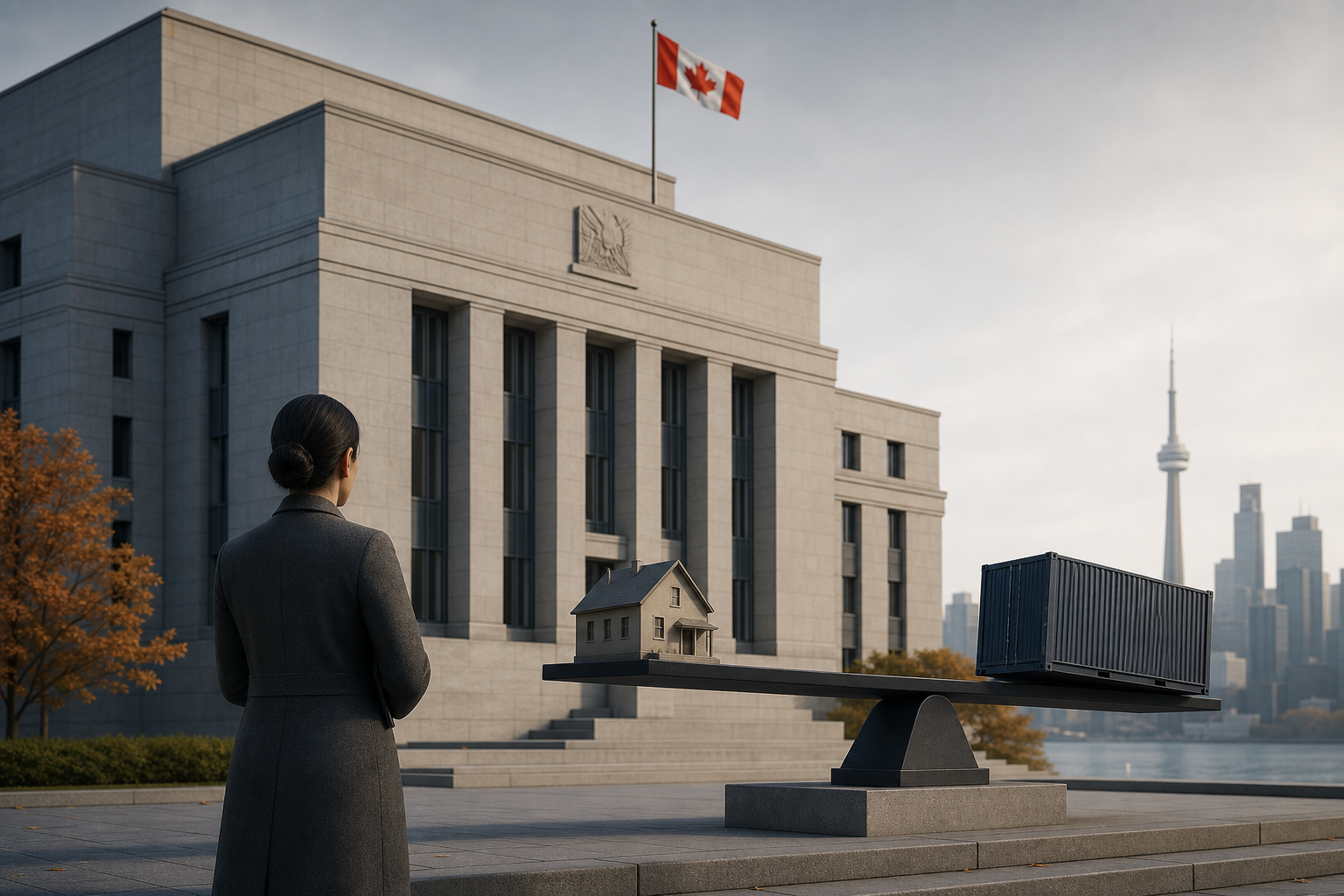
The conventional read on central bank inaction is caution. Policymakers waiting for more data. A prudent pause. That framing assumes the Bank of Canada is choosing to hold. It isn't. The choice got made for it by the shape of the Canadian economy in the back half of 2026, which is a household sector that cannot afford higher rates and an export base getting hammered by U.S. trade policy at the same time.
Here's the problem. Mortgage holders who locked in fixed rates between 2020 and early 2022 are renewing now, or will by early 2027. They borrowed at 1.79%, sometimes lower. They are renewing closer to 5%. That spread, applied to a $500,000 mortgage on a house in Vaughan, turns into roughly $650 more per month in carrying costs. You can't cut your grocery bill enough to absorb that. You can't accelerate your way out of it without selling. And the resale market in the Greater Toronto Area is down roughly 12% from its February 2022 peak, so selling means realizing a loss or walking away with less equity than the spreadsheet said you'd have.
That's the rate-hike constraint. The bank cannot tighten without turning a refinancing problem into a foreclosure wave.
The rate-cut constraint comes from the other direction. Canada ships $3.6 billion worth of goods across the border every day, according to Global Affairs Canada. When the U.S. administration floats a 25% tariff on steel or threatens reciprocal duties on Canadian energy exports, that's not background noise. It's a direct shock to the sectors that employ a meaningful share of workers in Ontario and Alberta. The last thing the Bank of Canada can afford is a weakening Canadian dollar that makes imports more expensive while export demand craters. A rate cut in this environment doesn't stimulate. It just makes inflation worse while doing nothing for the industries getting hit.
So the bank holds. Not because it thinks 2.25% is the Goldilocks number. Because moving in either direction opens a risk the institution cannot manage.
Governor Tiff Macklem will say something about monitoring developments and maintaining flexibility when the September decision gets announced. The language will be balanced. The subtext will be trapped.
The trade war didn't create this bind. Household debt that has concentrated almost entirely in mortgages, combined with an export base that runs through one customer, did that years ago. The tariff escalation in 2026 just makes it visible. The bank's policy rate has been on hold since October 2025, and the odds of a move in either direction were already near zero before Washington started floating new trade actions this summer.
What's left is a central bank that cannot tighten without breaking households and cannot ease without feeding inflation in an economy where external demand is collapsing. The only move available is no move. Call it prudence if you want. It's actually just the last option that doesn't make things immediately worse.



Bank of Canada Will Hold Through the Trade War Because It Has No Real Choice
The Bank of Canada's policy rate sits at 2.25% going into September 2026, and it will still be 2.25% when the year ends. That much was already settled before the latest round of tariff threats out of Washington. The escalating trade war didn't force the decision. It just removed what little room the bank had left to pretend otherwise.
The conventional read on central bank inaction is caution. Policymakers waiting for more data. A prudent pause. That framing assumes the Bank of Canada is choosing to hold. It isn't. The choice got made for it by the shape of the Canadian economy in the back half of 2026, which is a household sector that cannot afford higher rates and an export base getting hammered by U.S. trade policy at the same time.
Here's the problem. Mortgage holders who locked in fixed rates between 2020 and early 2022 are renewing now, or will by early 2027. They borrowed at 1.79%, sometimes lower. They are renewing closer to 5%. That spread, applied to a $500,000 mortgage on a house in Vaughan, turns into roughly $650 more per month in carrying costs. You can't cut your grocery bill enough to absorb that. You can't accelerate your way out of it without selling. And the resale market in the Greater Toronto Area is down roughly 12% from its February 2022 peak, so selling means realizing a loss or walking away with less equity than the spreadsheet said you'd have.
That's the rate-hike constraint. The bank cannot tighten without turning a refinancing problem into a foreclosure wave.
The rate-cut constraint comes from the other direction. Canada ships $3.6 billion worth of goods across the border every day, according to Global Affairs Canada. When the U.S. administration floats a 25% tariff on steel or threatens reciprocal duties on Canadian energy exports, that's not background noise. It's a direct shock to the sectors that employ a meaningful share of workers in Ontario and Alberta. The last thing the Bank of Canada can afford is a weakening Canadian dollar that makes imports more expensive while export demand craters. A rate cut in this environment doesn't stimulate. It just makes inflation worse while doing nothing for the industries getting hit.
So the bank holds. Not because it thinks 2.25% is the Goldilocks number. Because moving in either direction opens a risk the institution cannot manage.
Governor Tiff Macklem will say something about monitoring developments and maintaining flexibility when the September decision gets announced. The language will be balanced. The subtext will be trapped.
The trade war didn't create this bind. Household debt that has concentrated almost entirely in mortgages, combined with an export base that runs through one customer, did that years ago. The tariff escalation in 2026 just makes it visible. The bank's policy rate has been on hold since October 2025, and the odds of a move in either direction were already near zero before Washington started floating new trade actions this summer.
What's left is a central bank that cannot tighten without breaking households and cannot ease without feeding inflation in an economy where external demand is collapsing. The only move available is no move. Call it prudence if you want. It's actually just the last option that doesn't make things immediately worse.
Sources
Read Next
7 Essential Checks Before You Buy in 2026: Building Confidence Through the Numbers
Getting Lenders to Count 80% of Your Gross Rent: A Checklist
820 Low-Rise Homes, 129 Condos: The GTA Slump Belongs to Speculators
200 Basis Points or 2 Percentage Points: Same Stress Test, Clearer Wording