7 Ways to Seal Your Home Before Rodents and Insects Move In for Winter
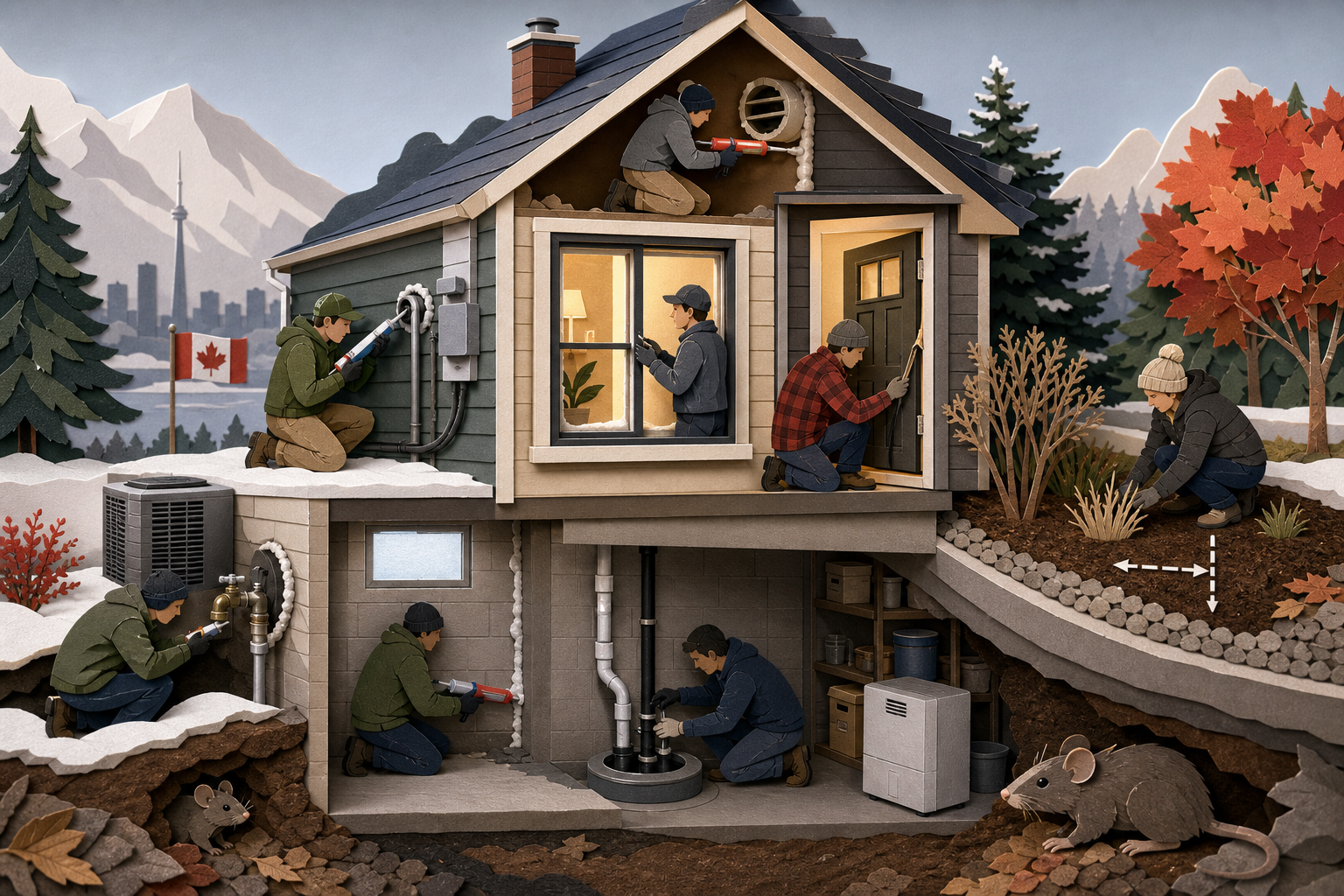
A mouse requires an opening no larger than a dime to slip into your attic. That's approximately 18 millimetres, roughly the diameter of a Canadian dime. A rat needs a space the size of the quarter itself. The thermal bridge effect, heat leaking through poorly sealed frames around windows and doors, acts as a navigational beacon for anything with fur or six legs looking to overwinter in November. What you're fighting isn't just entry. You're fighting temperature differential.
Here's the seven-step sequence that actually works, ordered by impact.
1. Caulk every penetration where a wire, pipe, or vent passes through the exterior envelope.
Cable hookups, dryer vents, outdoor faucet entry points, and basement window wells are the highest-density failure zones. Use polyurethane or silicone-based caulk rated for exterior use. The National Building Code of Canada lists proper caulking as the first line of defense against biological intrusion, not just air leakage. Check twice a year.
2. Install 6mm stainless steel mesh over all soffit vents and gable-end openings.
Heat rises. Your attic is the warmest space in the house once the furnace kicks on in October, making it the primary target for squirrels and raccoons. Standard aluminum screening fails. Rodents chew through it. Stainless mesh holds. Secure it with screws, not staples.
3. Replace worn weatherstripping on all exterior doors and add door sweeps with a rubber seal that contacts the threshold.
The gap under an exterior door, when weatherstripping has worn away, can reach 6 to 10 millimetres or more, more than enough clearance for Western Conifer Seed Bugs and ladybugs, both of which mass on south-facing walls in late September. Weatherstripping also reduces your heating bill. The dual benefit is why contractors call this "the energy-pest link."
4. Move firewood stacks at least 6 metres from the foundation and elevate them off the ground.
Woodpiles kept against the house facilitate the movement of carpenter ants and termites, both of which remain active until the ground freezes, typically not until late November in southern Ontario. Structural damage from unchecked infestations can run $3,000 to $10,000 or more in residential frames. Gravel or a clear 18-inch perimeter between the foundation and any mulch or vegetation removes the cover pests use to approach unseen.
5. Clean gutters and downspouts before the first hard frost and redirect downspout drainage at least two metres from the foundation.
Clean gutters and downspouts before the first hard frost and redirect downspout drainage at least 1.8 to 3 metres from the foundation. Clogged gutters provide standing water, which becomes a late-season breeding ground for mosquitoes and a water source for raccoons and squirrels. Damp basements caused by poor drainage attract silverfish and cockroaches, both of which treat moisture as life support during the dry indoor heating months.
6. Install one-way exclusion doors on known wildlife entry points rather than trapping.
Many Ontario municipalities restrict how far you can relocate a trapped animal under the Fish and Wildlife Conservation Act. Exclusion doors let trapped wildlife exit but block re-entry. Professional pest control services report that property managers implementing proactive fall hardening in September and October see roughly a 50 percent reduction in emergency pest calls by January.
7. Cover combustion air intakes and furnace exhausts with appropriately sized wire mesh, never solid caps.
Homeowners sealing indiscriminately create carbon monoxide risks. Furnaces and water heaters require venting. Use mesh designed for the vent diameter, typically 100mm or 150mm for residential gas appliances, so airflow isn't restricted while pests are blocked. Home inspectors flag this as the most commonly botched DIY exclusion step.
The item most people skip is the soffit screening in step two, which is also the one that prevents the most expensive damage.



A mouse requires an opening no larger than a dime to slip into your attic. That's approximately 18 millimetres, roughly the diameter of a Canadian dime. A rat needs a space the size of the quarter itself. The thermal bridge effect, heat leaking through poorly sealed frames around windows and doors, acts as a navigational beacon for anything with fur or six legs looking to overwinter in November. What you're fighting isn't just entry. You're fighting temperature differential.
Here's the seven-step sequence that actually works, ordered by impact.
1. Caulk every penetration where a wire, pipe, or vent passes through the exterior envelope.
Cable hookups, dryer vents, outdoor faucet entry points, and basement window wells are the highest-density failure zones. Use polyurethane or silicone-based caulk rated for exterior use. The National Building Code of Canada lists proper caulking as the first line of defense against biological intrusion, not just air leakage. Check twice a year.
2. Install 6mm stainless steel mesh over all soffit vents and gable-end openings.
Heat rises. Your attic is the warmest space in the house once the furnace kicks on in October, making it the primary target for squirrels and raccoons. Standard aluminum screening fails. Rodents chew through it. Stainless mesh holds. Secure it with screws, not staples.
3. Replace worn weatherstripping on all exterior doors and add door sweeps with a rubber seal that contacts the threshold.
The gap under an exterior door, when weatherstripping has worn away, can reach 6 to 10 millimetres or more, more than enough clearance for Western Conifer Seed Bugs and ladybugs, both of which mass on south-facing walls in late September. Weatherstripping also reduces your heating bill. The dual benefit is why contractors call this "the energy-pest link."
4. Move firewood stacks at least 6 metres from the foundation and elevate them off the ground.
Woodpiles kept against the house facilitate the movement of carpenter ants and termites, both of which remain active until the ground freezes, typically not until late November in southern Ontario. Structural damage from unchecked infestations can run $3,000 to $10,000 or more in residential frames. Gravel or a clear 18-inch perimeter between the foundation and any mulch or vegetation removes the cover pests use to approach unseen.
5. Clean gutters and downspouts before the first hard frost and redirect downspout drainage at least two metres from the foundation.
Clean gutters and downspouts before the first hard frost and redirect downspout drainage at least 1.8 to 3 metres from the foundation. Clogged gutters provide standing water, which becomes a late-season breeding ground for mosquitoes and a water source for raccoons and squirrels. Damp basements caused by poor drainage attract silverfish and cockroaches, both of which treat moisture as life support during the dry indoor heating months.
6. Install one-way exclusion doors on known wildlife entry points rather than trapping.
Many Ontario municipalities restrict how far you can relocate a trapped animal under the Fish and Wildlife Conservation Act. Exclusion doors let trapped wildlife exit but block re-entry. Professional pest control services report that property managers implementing proactive fall hardening in September and October see roughly a 50 percent reduction in emergency pest calls by January.
7. Cover combustion air intakes and furnace exhausts with appropriately sized wire mesh, never solid caps.
Homeowners sealing indiscriminately create carbon monoxide risks. Furnaces and water heaters require venting. Use mesh designed for the vent diameter, typically 100mm or 150mm for residential gas appliances, so airflow isn't restricted while pests are blocked. Home inspectors flag this as the most commonly botched DIY exclusion step.
The item most people skip is the soffit screening in step two, which is also the one that prevents the most expensive damage.
Sources
Read Next
7 Essential Checks Before You Buy in 2026: Building Confidence Through the Numbers
Getting Lenders to Count 80% of Your Gross Rent: A Checklist
820 Low-Rise Homes, 129 Condos: The GTA Slump Belongs to Speculators
200 Basis Points or 2 Percentage Points: Same Stress Test, Clearer Wording